About the Garden
-
Courtyard of Tranquility

It’s 16th century China, and you’re standing in the entry courtyard of the private home and garden of a wealthy family. The garden around you is their spiritual utopia, a peaceful and soothing place designed to help them escape the problems of everyday life and discover their true selves by connecting with nature.
-
Hall of Brocade Clouds

Take a moment to gaze through the beautifully-framed lattice doors and windows. This open view ensures that guests can see the family’s wealth and status in every direction. The intricately-carved gingko panels depict an important collection of plants known as Three Friends of Winter: plum, bamboo and pine.
-
Terrace

In the Ming Dynasty when the scholar gardens were at their peak, the ideal life was considered to be a hermit in the mountains, surrounded by nature. Since city life provided more comforts and pleasure, nature was brought to them—on a smaller scale.
-
Knowing the Fish Pavilion

The name of this pavilion comes from a conversation between two philosophers. Walking along a stream, one tells the other how happy he finds the fish to be. The other replies, “You are not a fish. How can you know that the fish are happy?” The first responds “You are not me. How do you know I don’t know the fish are happy?”
-
Reflections in Clear Ripples

In this room, also know as the Lounge House, the family would would gather for music, painting or playing games such as mahjong or wei chi.
-
Flowers Bathing in Spring Rain

Six panels carved from gingko wood illustrate actual ancient gardens in our sister city Suzhou. One panel contains two lines from poet Wen Zhengming (1470-1559): "Most cherished in this mundane world is a place without traffic; Truly in the midst of the city there can be mountain and forest."
-
Scholar's Courtyard

An extension of the Scholar's Study, the courtyard is a quiet place for reflection and inspiration. Symbols abound, including the plum trees and stone mosaic "plum blossoms on cracked ice" which signal the coming of spring and symbolize endurance and hope.
-
Scholar's Study
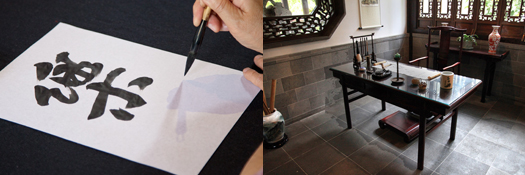
The Scholar's Study was where the men of the family studied for civil service exams that would ensure the family's prosperity. It served as a place of comfort for writing poetry, practicing calligraphy, reading and admiring art.
-
Moon Locking Pavilion

On a clear night, you can see the reflection of the moon as a shimmering spotlight in the center of the lake, locked in by the pavilion's shadow.
-
Tower of Cosmic Reflections

From this two-story building, women in the household would view the garden and surrounding city. Much of their time would be spent here managing the finances and affairs of the family. Today, it serves as the teahouse promoting the social art and culture of tea.
-
Painted Boat in Misty Rain

This pavilion represents the boat of friendship that departed from Suzhou and made its way across the ocean to Portland. From inside, you're meant to feel as if you're anchored on shore and being rocked by gentle waves.
Click a point on the map to discover more about Lan Su.
Discover Lan Su
Lan Su's visitor mobile app, Discover Lan Su, provides audio tours, interactive scavenger hunts, plant spotlight, and more.
Admission
Plan My Next Visit
A Contact-Free Visit
Enrich your garden visit and make it contact-free!
Discover Lan Su- Visitor APP for Audio Tours and Scavenger Hunts.
Lan Su is a gift I give myself.
Become A MemberI'm ready for a peaceful walk.
Plan a VisitHelp support this slice of paradise.
Make A GiftWhen flowers blossom along its railings, The willow bows low.
—Portion of illustrated panel, Flowers Bathing in Spring Rain
About
Visit
Support
Garden Address
239 Northwest Everett Street, Portland, Oregon 97209
Call Us: 503.228.8131
Mailing Address and Administrative Offices
Lan Su Chinese Garden
38 NW Davis St #260, Portland, OR 97209
Members, donors and visitors help keep Lan Su healthy and growing. Lan Su is a 501(c)(3) nonprofit organization and all donations and memberships are tax deductible. Lan Su’s Federal Tax ID number (EIN) is 93-1296840.